| June 2026 |
|---|
| Sun |
Mon |
Tue |
Wed |
Thu |
Fri |
Sat |
| |
1 |
2 |
3 |
4 |
5 |
6 |
| 7 |
8 |
9 |
10 |
11 |
12 |
13 |
| 14 |
15 |
16 |
17 |
18 |
19 |
20 |
| 21 |
22 |
23 |
24 |
25 |
26 |
27 |
| 28 |
29 |
30 |
|
|
|
|
|
|
The Perl Toolchain Summit 2026: Security, Testing, Porting and Community Collaboration
Furnished content.
From April 23-26, 2026, the invite-only Perl Toolchain Summit (PTS) brought together about 30 of the ecosystem's most active maintainers including four first-timers in Vienna, Austria for four days of uninterrupted deep-dive collaboration in pair-programming sessions, consensus discussions, and critical infrastructure work. Attendees tackled security tooling and infrastructure, modernization and redesign proposals, several CI and test harness improvements, Perl core optimizations, and metadata/spec updates.Thanks to all the sponsors’ support (financial, in-kind, and community), this year’s Summit was a success. It produced multiple module releases, consensus on future smoke-testing and CPAN Testers architecture, and a new CPANSec advisory feed that will allow developers to quickly assess any Perl project’s security using either CLI tools or the MetaCPAN website itself. Those advancements benefit all organizations relying on Perl directly or indirectly.PTS 2026 Key Results & DeliverablesSecurityCPANSec took it to another level, getting faster at discovering vulnerabilities (in modules, infrastructure and core) and improving its process:- Vulnerability triage;
- CNA improvements;
- Meta V3 is moving forward;
- Deprecated Module::Signature, considered “security theater”.
Testing and Quality AssuranceTesting and QA work included:- On the road to Devel::Cover 2.00;
- Several improvements made to Test::Smoke, with 3 releases: removal of dual PerlIO/stdio testing, making install more robust (and portable);
- Test::Smoke backend full rewrite to ensure sustainability with new features and better performance;
- The Test2 family of modules, including the new web user interface, was greatly improved, with many issues fixed and new features implemented;
- Syncing from backpan.perl.org to fill in CPAN Testers’ backpan;
- New MCP server mcp.cpantesters.org to browse CPAN Testers reports from your preferred LLM CLI.
Supply Chain and Other ModulesMany CPAN authors and maintainers worked on:PAUSEVery hacktive PAUSE table:- Implemented new API token access;
- Security fixes (“rand rand rand rand”, “ABRA time” and “META symlinks”);
- New dockerized PAUSE;
- Various pentesting (e.g. reviewing YAML parser);
- Ongoing work on OAuth/OIDC;
- Several Pull Requests merged.
FundingRecent years brought the topic of funding to the front of the stage. In particular to ensure the sustainability of Perl maintenance funds, accelerate some initiatives (e.g. CPAN Security efforts) and finance community events (like this one!).A lot of things happened on this front during the Perl Toolchain Summit:- A strong effort towards funding security work;
- General discussions about funding of the community.
Group discussionsThe Perl Toolchain Summit also provides a lot of opportunity for interaction.Whether they’re corridor discussions, small talk to get to know each other and build trust, discussions around a drink or group discussions (that led in the past to “consensus” or “amendment” papers), it all ends up strengthening the Perl toolchain.During this PTS in particular, there were a lot of group discussions, probably helped by having a dedicated meeting room.On the topic of AI- AI Policies Materials
- AI Policies Governance
- Share your AI tooling and tips!
On the topic of SecurityOn the topic of Perl core- Perl Ongoing and future features
- Perl core class/roles implementation
- Configure
- UTF-8
- Plan for Perl Platforms
PodcastsAs in 2025, PTS 2026 was an opportunity to record new episodes for The Underbar.There were over five hours of conversations recorded, about:- Configure
- Vienna.pm
- PPI
- the Perl Steering Council
- Karl Williamson
Bringing 30-35 experts under one roof enabled unprecedented collaboration with real-time problem solving, saving months of remote coordination and alignment. That kind of accelerated development and knowledge transfer not only brings the community together but fuels the contributors of critical open source projects for the rest of the year so they can renew their shared goals and work in the same direction. Having four first-time attendees gaining direct mentorship is also fundamental to seed future contributions and expand the volunteer base, ensuring the longevity of the Perl ecosystem and toolchain.The continued support of our sponsors ensures that the Perl Toolchain Summit remains a catalyst for Perl sustainability translating sponsor investment into tangible improvements in performance, security, and ecosystem features and coherence. We look forward to partnering again to power the next wave of innovation in Perl’s toolchain.- The Perl and Raku Foundation,
- Grant Street Group,
- Geizhals Preisvergleich,
- Vienna.pm,
- SUSE,
- Trans-Formed Media LLC,
- Ctrl O,
- Simplelists,
- HKS3 / Koha Support,
- Harald Jrg,
- Michele Beltrame (Sigmafin),
- Laurent Boivin.
Read more here
posted at: 12:00am on 14-May-2026
path: /Programming/Perl | permalink | edit (requires password)
I saw Framework's new 'MacBook Pro for Linux users' and it may entice Windows fans, too
Furnished content.
Years of user feedback have led to the new Framework Laptop 13 Pro, an ultraportable device that's both modular and premium.
Read more here
posted at: 12:00am on 22-Apr-2026
path: /Technology | permalink | edit (requires password)
Podlite comes to Perl: a lightweight block-based markup language for everyday use
Furnished content.
My name is Alex. Over the last years I've implemented several versions of the Raku’s documentation format (Synopsys 26 / Raku’s Pod) in Perl and JavaScript.At an early stage, I shared the idea of creating a lightweight version of Raku’s Pod, with Damian Conway, the original author of the Synopsys 26 Documentation specification (S26).He was supportive of the concept and offered several valuable insights that helped shape the vision of what later became Podlite.Today, Podlite is a small block-based markup language that is easy to read as plain text, simple to parse, and flexible enough to be used everywhere in code, notes, technical documents, long-form writing, and even full documentation systems.This article is an introduction for the Perl community what Podlite is, how it looks, how you can already use it in Perl via a source filter, and what's coming next.The Block Structure of PodliteOne of the core ideas behind Podlite is its consistent block-based structure.Every meaningful element of a document a heading, a paragraph, a list item, a table, a code block, a callout is represented as a block. This makes documents both readable for humans and predictable for tools.Podlite supports three interchangeable block styles: delimited, paragraph, and abbreviated.Abbreviated blocks (=BLOCK)This is the most compact form.A block starts with = followed by the block name.=head1 Installation Guide=item Perl 5.8 or newer=para This tool automates the process.
- ends on the next directive or a blank line
- best used for simple one-line blocks
- cannot include configuration options (attributes)
Paragraph blocks (=for BLOCK)Use this form when you want a multi-line block or need attributes.=for code :lang<perl>say "Hello from Podlite!";
- ends when a blank line appears
- can include complex content
- allows attributes such as
:lang, :id, :caption, :nested,
Delimited blocks (=begin BLOCK =end BLOCK)The most expressive form. Useful for large sections, nested blocks, or structures that require clarity.=begin nested :notify<important>Make sure you have administrator privileges.=end nested
- explicit start and end markers
- perfect for code, lists, tables, notifications, markdown, formulas
- can contain other blocks, including nested ones
These block styles differ in syntax convenience, but all produce the same internal structure.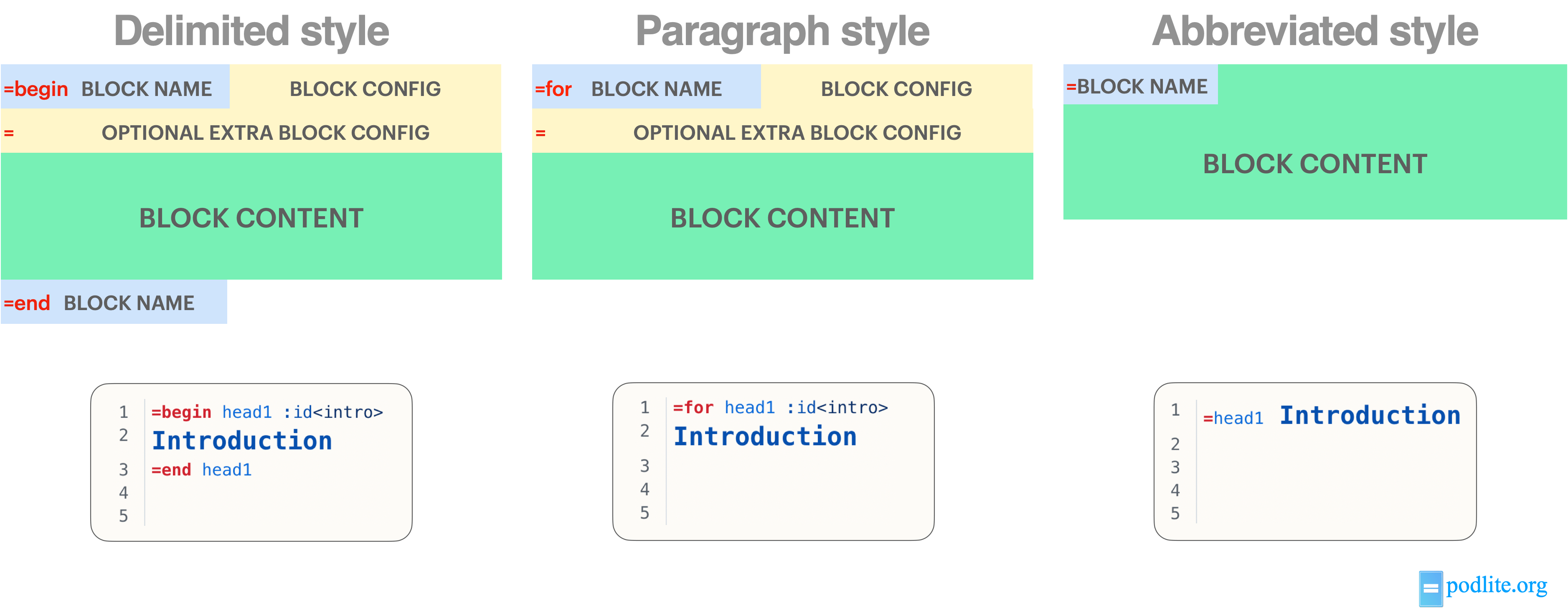 Regardless of which syntax you choose: Regardless of which syntax you choose:- all three forms represent the same block type
- attributes apply the same way (
:lang, :caption, :id, ) - tools and renderers treat them uniformly
- nested blocks work identically
- you can freely mix styles inside a document
Example: Comparing POD and PodliteLet’s see how the same document looks in traditional POD versus Podlite: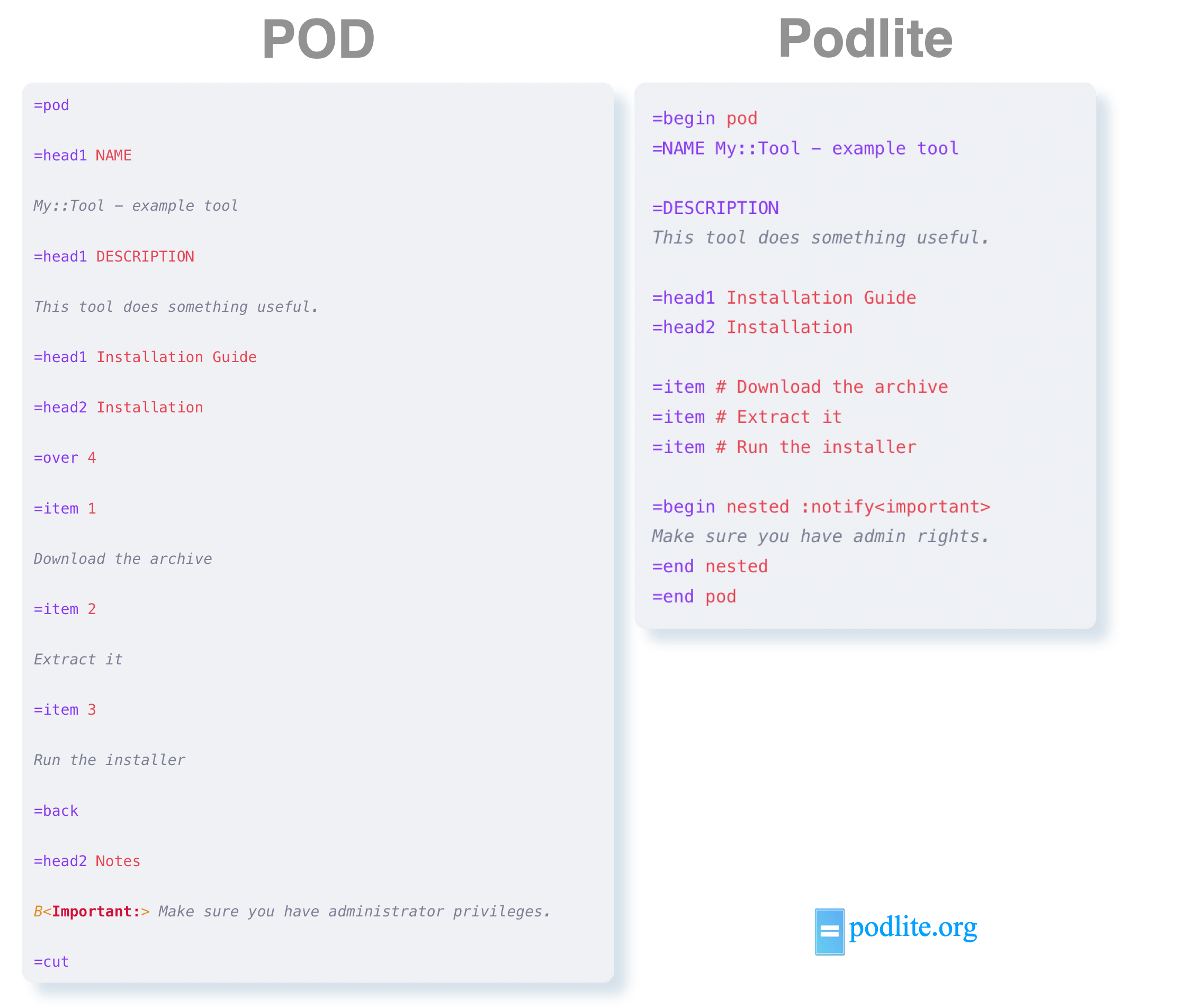 Each block has clear boundaries, so you don’t need blank lines between them. This makes your documentation more compact and easier to read.This is one of the reasons Podlite remains compact yet powerful:the syntax stays flexible, while the underlying document model stays clean and consistent.This Podlite example rendered as on the following screen: Each block has clear boundaries, so you don’t need blank lines between them. This makes your documentation more compact and easier to read.This is one of the reasons Podlite remains compact yet powerful:the syntax stays flexible, while the underlying document model stays clean and consistent.This Podlite example rendered as on the following screen: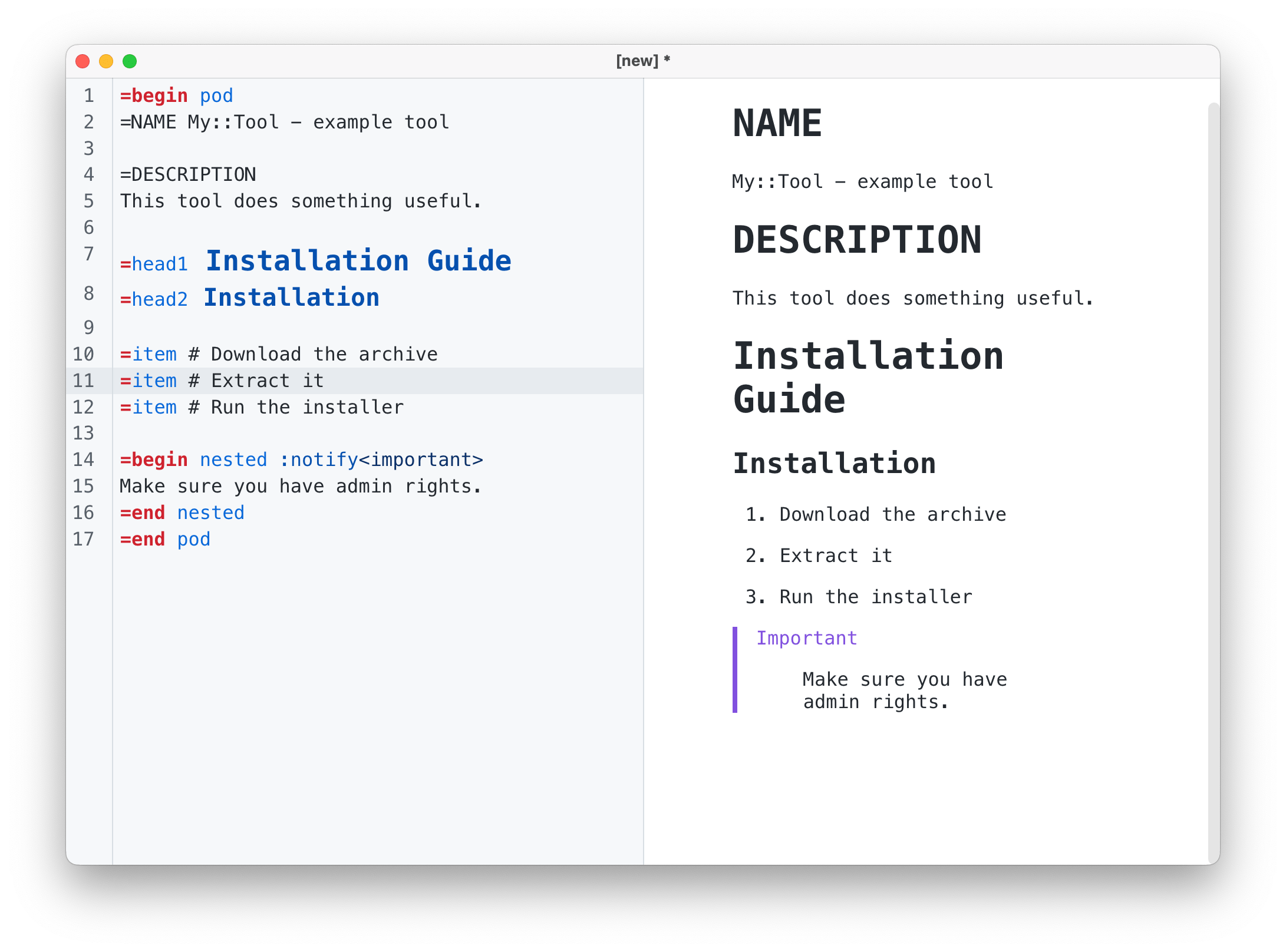 Inside the Podlite Specification 1.0One important point about Podlite is that it is first and foremost a specification.It does not belong to any particular programming language, platform, or tooling ecosystem.The specification defines the document model, syntax rules, and semantics.From the Podlite 1.0 specification, notable features include:- headings (
=head1, =head2, ) - lists and definition lists, and including task lists
- tables (simple and advanced)
- CSV-backed tables
- callouts / notifications (
=nested :notify<tip|warning|important|note|caution>) - table of contents (
=toc) - includes (
=include) - embedded data (
=data) - pictures (
=picture and inline P<>) - formulas (
=formula and inline F<>) - user defined blocks and markup codes
- Markdown integration
The =markdown block is part of the standard block set defined by the Podlite Specification 1.0.This means Markdown is not an add-on or optional plugin it is a fully integrated, first-class component of the language.Markdown content becomes part of Podlite's unified document structure, and its headings merge naturally with Podlite headings inside the TOC and document outline.Below is a screenshot showing how Markdown inside Perl is rendered in the in-development VS Code extension, demonstrating both the block structure and live preview: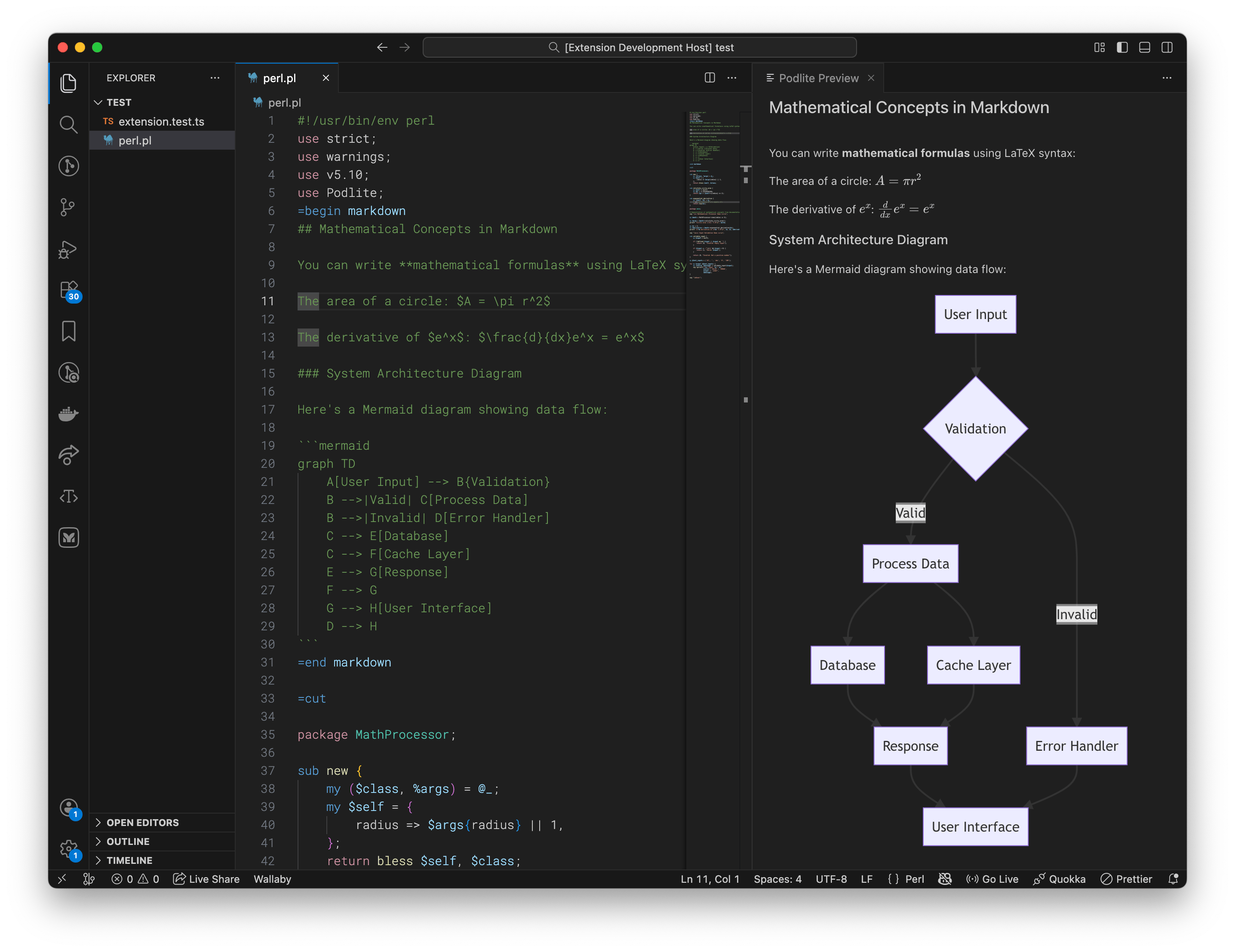 Using Podlite in Perl via the source filterTo make Podlite directly usable in Perl code, there is a module on CPAN:Podlite Use Podlite markup language in Perl programsA minimal example could look like this:use Podlite; # enable Podlite blocks inside Perl=head1 Quick Example=begin markdownPodlite can live inside your Perl programs.=end markdownprint "Podlite active\n";
Roadmap: what’s next for PodlitePodlite continues to grow, and the Specification 1.0 is only the beginning.Several areas are already in active development, and more will evolve with community feedback.Some of the things currently planned or in progress:- CLI tools
- command-line utilities for converting Podlite to HTML, PDF, man pages, etc.
- improve pipelines for building documentation sites from Podlite sources
- VS Code integration
- Ecosystem growth
- develop comprehensive documentation and tutorials
- community-driven block types and conventions
Try Podlite and share feedbackIf this resonates with you, I'd be very happy to hear from you:- ideas for useful block types
- suggestions for tools or integrations
- feedback on the syntax and specification
https://github.com/podlite/podlite-specs/discussionsEven small contributions a comment, a GitHub star, or trying an early tool help shape the future of the specification and encourage further development.Useful links:Thanks for reading,Alex
Read more here
posted at: 12:00am on 28-Jan-2026
path: /Programming/Perl | permalink | edit (requires password)
I found the most useful parenting gadgets at CES 2026 - these are the ones I'd buy ASAP
Furnished content.
From a real-time breastfeeding monitor to a cute bladeless stroller fan, we've found some of the most interesting tech aimed at parents and children at CES.
Read more here
posted at: 12:00am on 06-Jan-2026
path: /Technology | permalink | edit (requires password)
| June 2026 |
|---|
| Sun |
Mon |
Tue |
Wed |
Thu |
Fri |
Sat |
| |
1 |
2 |
3 |
4 |
5 |
6 |
| 7 |
8 |
9 |
10 |
11 |
12 |
13 |
| 14 |
15 |
16 |
17 |
18 |
19 |
20 |
| 21 |
22 |
23 |
24 |
25 |
26 |
27 |
| 28 |
29 |
30 |
|
|
|
|
|
|